
Getting your dog used to a harness: Here's how to do it stress-free

The harness is ready, the walk awaits – but your dog shrinks down, avoids you, or tries to escape. Sound familiar? You're not alone.
Many dogs were never properly trained to wear a harness. It was simply put on, and that was that. This works for some – for others it leads to stress, avoidance behavior, or daily tugging. The good news: With the right training, putting on the harness becomes a relaxed routine.
The most important points in brief
- Basic principle: Dishes = positive association. Treats, praise, good experiences.
- Pace: Better too slow than too fast. Small steps, no rush.
- Puppies: Start early, short sessions, build up through play.
- Adult dogs: Still possible later on – it just requires a little more patience.
- If the dog is afraid: Do not lure or force it. Let the dog decide for itself.
Why even use a dish set?
In short: The harness distributes pressure across the chest and back, instead of concentrating it on the sensitive neck. This is especially important for dogs that (still) pull on the leash, protecting them from injuries to the larynx, trachea, and cervical spine.
A harness is almost essential for puppies. They are impulsive, boisterous, and haven't yet learned to walk calmly on a leash. Any sudden jerk on the collar can cause injury. A well-fitting harness ensures your puppy's safety.
Getting puppies used to a harness
The sooner you start, the better. As soon as your puppy has settled in – usually after a few days – you can begin getting it used to the harness. The goal: Your puppy should associate the harness with positive things, not with stress or coercion.
Step 1: Getting to know the dishes
Simply place the harness on the floor near your puppy. Let him sniff it, examine it, and perhaps chew on it. Reward every voluntary approach with a treat or praise. This will help the harness become a neutral to positive object.
Step 2: Practice putting your head through
Hold the harness with the head opening at ground level (don't lean over the dog from above – many dogs find this threatening). Lure your puppy through the opening with a treat. He'll voluntarily put his head through and get the reward. Done. The harness stays open, you praise him, and then you do something else.
Repeat this several times a day until your puppy enthusiastically sticks its head through as soon as you lay down the harness.
Step 3: Close the dish
Only when step 2 goes smoothly should you fasten the harness. Give a quick compliment, a treat – and then immediately open it again. Your puppy needs to learn: harness fastened = reward. Wearing it will come later.
Step 4: Short wearing times
Now the harness can stay on for a few minutes. Distract your puppy: play with him, let him sniff around, do something he loves. This way he'll forget about the harness and associate it with positive experiences. After a few minutes, take it off again – before he starts scratching at it or trying to get rid of it.
Step 5: Get it out
Once your puppy is comfortably wearing the harness indoors, it's time to go outside. There, he'll be distracted by all the exciting smells and sights anyway. Most puppies completely forget about the harness once they're outside.
Training sessions: For puppies, 2-3 minutes per session is sufficient, but several times a day. Short and positive is better than long and frustrating.
Getting adult dogs used to a harness
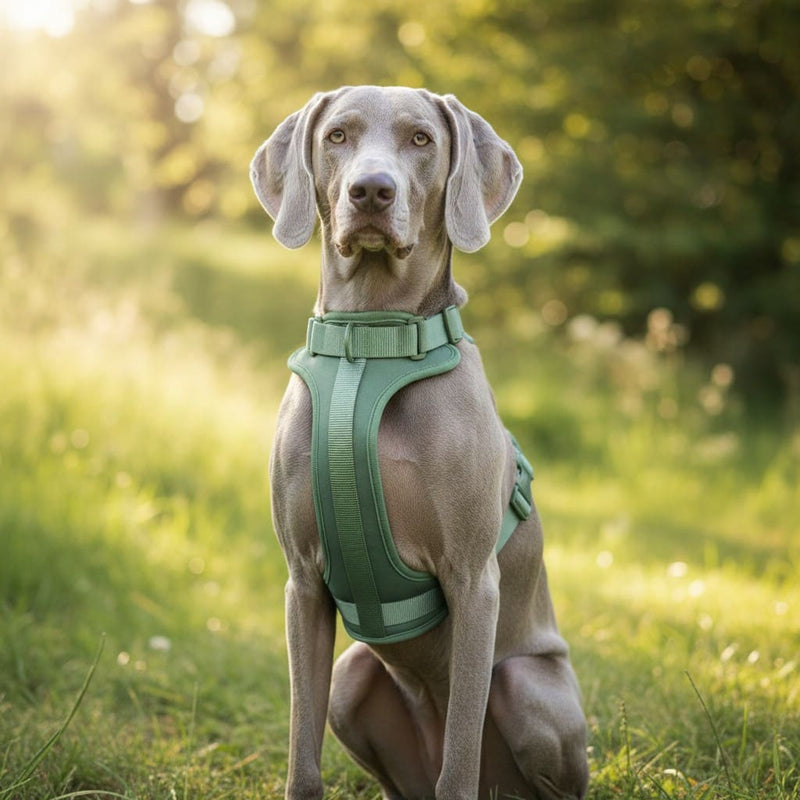
Even with adult dogs, habituation works according to the same principle – it just may take a little longer, especially if there have been bad experiences.
Many adult dogs have worn a collar for years and are unfamiliar with harnesses. Others previously had a poorly fitting harness that pinched or rubbed. Both lead to avoidance behavior.
The procedure is identical: let the dog become familiar with the dishes, build a positive association, and gradually increase the amount. Only more patience is required.
Switching from a collar
If your dog has only ever worn a collar, a harness will be unfamiliar at first. Some dogs accept it immediately, others need time. Important: Don't force anything. A few days or weeks of training are better than a dog that runs away every time it sees the harness.
If the dog is afraid of the harness
Some dogs exhibit clear avoidance behavior: they cower, evade, run away, or freeze as soon as the harness appears. This often happens if the familiarization phase was skipped or if putting the harness on was unpleasant in the past.
The most important rule: Don't lure, don't force.
It sounds paradoxical, but: If you lure your dog to its harness with treats, it will go despite its fear – because it wants the reward, not because it feels comfortable. This exacerbates the problem in the long run.
Better: Let your dog decide for himself. Place the harness near him, ignore it, do something else. Reward every voluntary approach – even just a glance. This way, your dog will build trust at his own pace.
Neutralize dishes
Integrate the harness into your daily routine without wearing it. Carry it around with you, put it on the sofa, take it into the kitchen. It should become a completely normal object, without any special significance. Only when your dog no longer reacts when you touch the harness should you begin the actual training.
Step-in harnesses as an alternative
Some dogs have a specific problem: they hate having anything pulled over their head. For these dogs, a step-in harness can be an option – the dog steps into it with its front legs, and the harness is fastened at the back. No need to pull it over the head. However, with patient training, most dogs will also get used to classic Y-harnesses.
Dog bites the harness – what to do?
Puppies love to chew on everything, including their harnesses. This is normal and usually stops on its own as the dog gets older. Important: Don't scold, distract your puppy. As soon as the harness is on, start a game or go outside – then your puppy will have something better to do than chew on the harness.
In adult dogs, biting at the harness can be a sign of stress or discomfort. Does the harness fit correctly? Is it pinching or rubbing anywhere? If so, a different model or size might be the solution.
Finding the right tableware
Getting your dog used to the harness will only work if it fits well. A harness that's too tight will pinch, while one that's too loose will slip and be uncomfortable. Both will cause your dog to reject it.
What you should pay attention to
- Not restrictive: Your dog must be able to move freely, especially the shoulders.
- Not too loose: Two fingers should fit flat under each strap – no more.
- Avoid chafing: Pay special attention to the armpits and chest area.
- Adjustable: A good harness can be adjusted in several places.
- Lightweight material: Especially important for puppies and small dogs
Unsure about the size? Here you'll find our size chart and measuring instructions .
The most common mistakes
Mistake 1: Proceeding too quickly
Simply putting the harness on and hoping the dog gets used to it works for some, but not for many. Take your time with each step.
Mistake 2: Bending over the dog
Dogs find bending over threatening. It's better to squat or sit on the ground when putting on the harness. This makes you appear smaller and less intimidating.
Mistake 3: Only practicing before the walk
If you only put the harness on when you're going out, your dog will get excited and impatient – and so will you. Practice in between walks, without actually going for a walk. That way, you'll both stay relaxed.
Error 4: Ignoring signals
Puppies also show signs of discomfort: turning their head away, crouching down, freezing. If you ignore these signals and continue anyway, you'll reinforce the avoidance behavior. Pay attention to your dog.
Mistake 5: The wrong dishes
Sometimes the problem isn't the training, but the harness itself. If it pinches, rubs, or slips, your dog will never like it – no matter how many treats you give.
Frequently Asked Questions
At what age can I start getting my puppy used to a harness?
Once he's settled in with you – usually after a few days. At around 8 weeks, you can slowly begin. Important: Short sessions, no pressure, lots of praise.
My dog hates it when things are pulled over his head. What should I do?
Practice putting your dog's head through the harness in very small steps: Hold the harness low, lure your dog with treats, and let them decide. With patience, most dogs will get used to it. Alternatively, there are step-in harnesses where the dog steps in with its front legs.
How long does it take to get used to it?
For puppies without prior trauma: often only a few days. For adult dogs with bad experiences: weeks to months. Every dog is different – don't put yourself under pressure.
My dog accepts the harness outside, but not inside. Is that normal?
Yes, that happens. Outside, your dog gets distracted and forgets his harness. Inside, he's more likely to notice it. Practice indoors too – otherwise, putting him on will always be stressful.
Harness or collar – which is better?
For most dogs, a harness is the better choice because it distributes pressure and protects the neck. A harness is especially recommended for puppies, dogs that pull on the leash, or breeds with sensitive airways (Pugs, French Bulldogs).
Conclusion
Getting your dog used to a harness takes time, patience, and lots of treats – but it's worth it. A dog who loves their harness (or at least calmly accepts it) makes every walk more relaxing. For both of you.
The most important thing: small steps, positive reinforcement, no force. And if your dog has had bad experiences – proceed even more slowly. It's never too late to rebuild the harness training.
The perfect harness for your dog
A good harness is comfortable, easy to put on, and looks good too. Our Y-harnesses SELKA and STYRA distribute pressure evenly and allow your dog complete freedom of movement.
Discover all harnesses →