
Dog pulls on the leash: What really helps

The classic dog problem: You want to go for a relaxing walk, but your dog has other plans. He pulls, tugs, wheezes – and you get dragged from one sniffing spot to the next. This isn't fun for either you or your dog.
The good news: Pulling on the leash is not a character flaw, but a learned behavior. And what has been learned can also be unlearned.
The most important points in brief
- Why dogs pull: Because it works – they get to their destination faster.
- Key principle: Pulling should never lead to success.
- Training: Stop, change direction, reward attention
- Equipment: A harness instead of a collar protects the neck
- Important: Consistency – always and everywhere, not just during "training"
Why does my dog pull on the leash?
The answer is simple: because it works. Your dog has learned that pulling gets him to his destination faster. To that interesting scent mark, to the other dog, to the next corner. The more he pulls, the faster he goes. This is a rewarding experience for him – and successes are repeated.
Furthermore, walking on a leash is unnatural for dogs. They want to sniff, explore, and go at their own pace. The leash restricts this. No wonder many dogs resist it.
Common causes at a glance
- He's never known any other way: even as a puppy he was allowed to pull – now it's a habit.
- Understimulation: Too little exercise or mental activity = excess energy
- Excitement: Other dogs, smells, stimuli – everything must be explored IMMEDIATELY.
- Boring walks: Always the same route, no variety, the dog becomes a "secondary matter"
- Inconsistency: Sometimes he's allowed to pull, sometimes not – confusing for the dog.
The problem: Why pulling is harmful
Pulling on the leash isn't just annoying for you – it also harms your dog:
- Cervical spine: Constant tension on the neck strap puts strain on the larynx and cervical vertebrae.
- Tension: In the neck and shoulder area due to the unnatural posture
- Shortness of breath: The typical wheezing indicates that the dog is being forced to breathe.
- Stress: The constant pressure on the neck is unpleasant and stressful.
And what about you? Sore shoulders, tendonitis, in the worst case falls – especially with large, strong dogs.
The training: 3 methods that work
Method 1: Standing still
The principle is simple: As soon as there's tension on the leash, you stop. Rooted to the spot. Without a word, without looking at your dog. You wait until he looks at you or the leash goes slack. Then you continue – with lots of praise.
Here's how it works:
- Leash taut → stop immediately
- Wait until the dog looks at you or comes back.
- Praise and move on
- If you pull again: stop again.
Attention: In the first few training sessions, you will stop every few meters. This is normal. Be patient.
Method 2: Change of direction
If your dog pulls forward, turn around without a word and walk in the other direction. Your dog must follow you. If he pulls again, turn around again. This is how he learns: It's worth paying attention to you, because otherwise he'll never know where you're going.
Here's how it works:
- Dog pulls → you turn around (without jerking the leash)
- Dog follows → praise
- Dog pulls again → turn around again
- Repeat until the dog pays attention to you.
Method 3: Reward attention
Instead of just "punishing" unwanted behavior (by stopping), you actively reward the right thing: Every time your dog looks at you, walks beside you, or the leash is loose, you give praise or a treat.
Here's how it works:
- Dog looks at you → "Good boy/girl!" + treat
- Dog walks beside you on a loose leash → praise
- Dog looks to you for guidance → reward
This makes it attractive for your dog to stay with you – not because pulling is "forbidden", but because not pulling is worthwhile.
The right equipment
Harness instead of collar
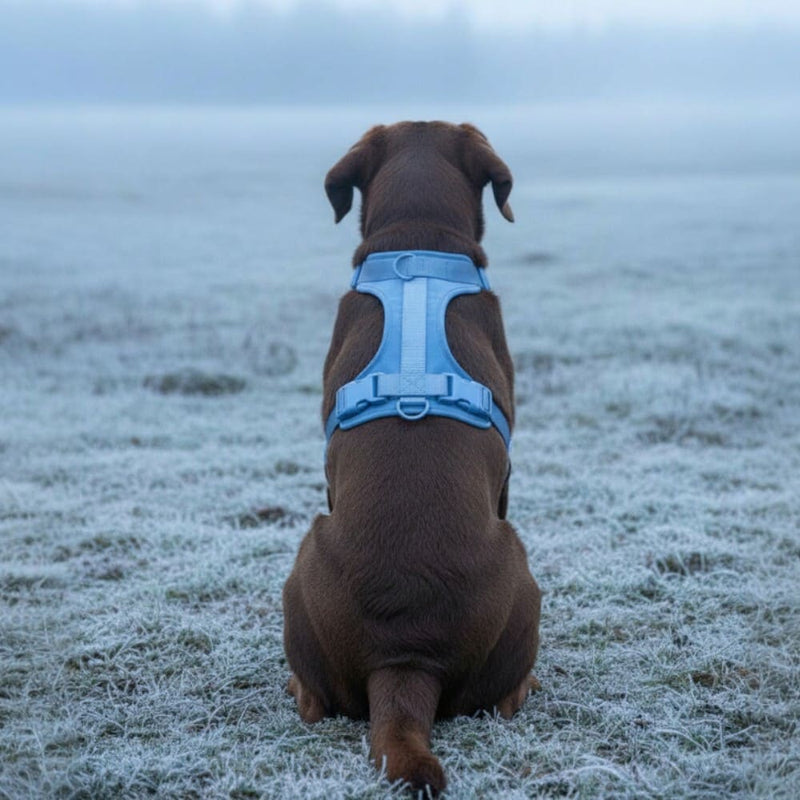
When training a dog on a leash, a well-fitting harness is better than a collar. The pressure is distributed across the chest and back instead of the sensitive neck. This is especially important for dogs that still pull strongly.
Important: The harness must fit correctly – not too tight, not too loose, and without chafing. You can find our size chart here.
The right leash
A standard fixed-length leash (approx. 1.5-2 meters) is suitable for training. Do not use a retractable leash! This teaches the dog: "The more I pull, the more leash I get" – exactly the opposite of what you want to train.
Stay away from: prong collars, choke collars, and other "training aids" that use pain. They may work in the short term, but they destroy your dog's trust and can lead to serious injuries.
The most common mistakes
Mistake 1: Inconsistency
The biggest mistake: Sometimes the dog is allowed to pull, sometimes not. In the morning you're stressed and let yourself be dragged to your favorite meadow, in the evening you train. This is confusing for your dog – he doesn't understand when pulling is okay and when it isn't. The rule must always apply.
Mistake 2: Pulling on the dog
If your dog pulls and you pull back, it creates a tug-of-war. This only makes the problem worse. Instead: Stop or change direction – calmly and without jerking.
Error 3: Insufficient utilization
An under-stimulated dog has excess energy – and that energy needs to be released. Before you start leash training, your dog should already be somewhat worn out. A short game or some mental stimulation before the walk helps.
Mistake 4: Boring walks
If your dog finds the walk boring, he'll find his own entertainment – and head off to the next interesting spot. Make the walk more exciting: change direction, play search games, do short training sessions. This will help your dog focus more on you.
Mistake 5: Only training on the dog training field
Many dogs are model students at dog training school – and still pull at home. Training must take place in everyday life, not just at the dog training field. Every walk is training.
How long does the training last?
It depends on how long your dog has been pulling and how consistently you train. With puppies, it usually happens quickly. With adult dogs that have been allowed to pull for years, it can take weeks or months.
Important: Improvement won't be linear. There will be good days and bad days. Setbacks are normal. Stick with it.
When to go to a dog trainer?
Sometimes there's more to leash pulling than meets the eye: leash aggression, extreme anxiety, or the dog is so agitated that it's completely unresponsive. In these cases, it's worth working with a professional dog trainer who can assess the situation on-site.
Frequently Asked Questions
My dog only seeks out other dogs. What should I do?
This is often a sign of excitement (positive or negative). First, train at a distance: let your dog see other dogs, but not approach them. Reward calm behavior. Only when that works can you reduce the distance.
Does a Halti/head halter help?
Haltis can be helpful for very strong dogs, but should only be used under the guidance of a trainer. They are not a substitute for proper training, but rather a tool for the transition period.
My dog only pulls when there are certain stimuli (cats, birds). Is that normal?
Yes, that's the hunting instinct. A good recall signal and impulse control training can also help. However, the basic principle remains the same: pulling doesn't lead to success.
At what age can I start training?
As early as possible. Even puppies can learn to walk on a loose leash. The earlier you start, the easier it is – because pulling hasn't yet become a habit.
Conclusion
Pulling on the leash is annoying, but not inevitable. With consistency, patience, and the right methods, every dog can learn to walk calmly on a leash. Most importantly: pulling should never be successful. And: training doesn't just happen at the dog park, but on every walk.
The right equipment for relaxed walks
A well-fitting harness distributes pressure evenly and protects your dog's neck. Together with our leash , you'll be perfectly equipped for training.
To the tableware → To the lead rope →